

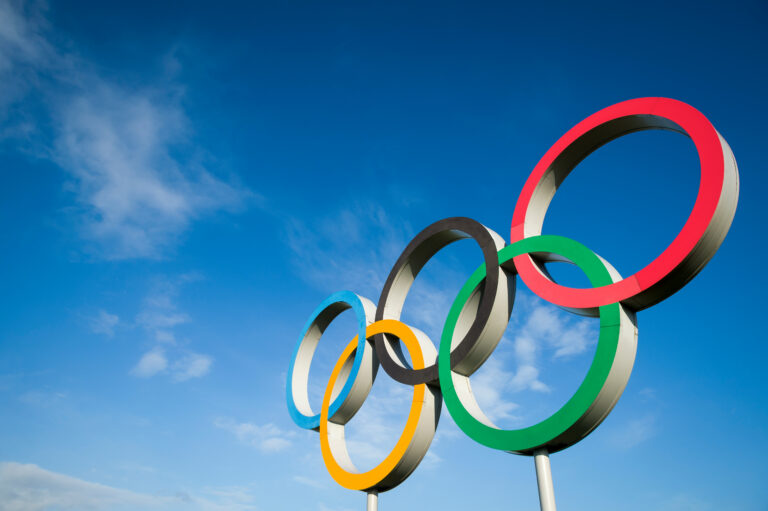
1. The Olympic Rings Are a Symbol of Global Unity 🏅
The five interlocked rings are one of the most recognizable symbols on Earth. Designed in 1913 by Pierre de Coubertin, founder of the modern Olympic movement, they represent the union of the five inhabited continents: Africa, the Americas, Asia, Europe, and Oceania.
The six colours—blue, yellow, black, green, and red on a white background—were chosen because every national flag in the world contains at least one of them. The rings overlapping symbolize how the Games bring athletes from all over the world together in peaceful competition.
2. The Four-Year Cycle is a 3,000-Year-Old Tradition
Have you ever wondered why we wait four years for the Olympics? This tradition is not a modern logistical choice, but an ancient one. The original Games in Olympia, Greece, were held every four years as part of a religious festival honouring Zeus.
This four-year period was so important that historians used it as a measurement of time, calling it an “Olympiad”. When the modern Games were revived in 1896, the founders kept the four-year cycle to honour this ancient heritage and to allow adequate time for preparation and athlete training.
3. Summer and Winter Games Split Up in the 1990s
For most of the 20th century, the Summer and Winter Olympics were held in the same year. The last “twin” Games were in Barcelona and Albertville in 1992.
In 1986, the International Olympic Committee (IOC) decided to alternate them. They placed the Winter Games in the middle of the Summer Games’ four-year cycle, creating a major sporting event every two years. This change took effect in 1994 with the Lillehammer Winter Games, meaning we now enjoy Olympic excitement more frequently.
4. The Games Have Been Canceled or Postponed Six Times
Since the modern era began in 1896, the Olympics have only been disrupted six times, and war has been the primary cause.
Here is a summary of those major disruptions:
| Event | Location | Fate | Reason |
| 1916 Summer Games | Berlin, Germany | Canceled | World War I |
| 1940 Summer Games | Tokyo, Japan / Helsinki, Finland | Canceled | World War II |
| 1940 Winter Games | Garmisch-Partenkirchen, Germany | Canceled | World War II |
| 1944 Summer Games | London, United Kingdom | Canceled | World War II |
| 1944 Winter Games | Cortina d’Ampezzo, Italy | Canceled | World War II |
| 2020 Summer Games | Tokyo, Japan | Postponed to 2021 | COVID-19 Pandemic |
5. The Flame is a Link to Ancient Greece
 The lighting of the Olympic flame is a direct tribute to the Games’ origins. In ancient Olympia, a sacred flame burned on the altar of the goddess Hestia throughout the celebration.
The modern tradition began in 1928. Today, the flame is still lit in Olympia using the sun’s rays and a parabolic mirror in a ceremony at the Temple of Hera. It then embarks on a relay to the host city, traveling by every means imaginable—runner, boat, plane, camel, canoe, and even underwater. This journey symbolically connects the ancient world with the modern host nation.